
JMeter vs k6: when to keep JMeter, when arrival-rate needs k6
Decision table for SaaS teams: when JMeter stays, when k6 fits CI, and an arrival-rate scenario that closed-loop VU counts get wrong.
You are picking the tool for the next load gate on an API or SaaS backend — not crowning a winner for every company on earth.
This page is a decision table plus one arrival-rate scenario that closed-loop “N virtual users” tests often mis-measure. For how to write realistic k6 tests (open vs closed, thresholds, coordinated omission), see realistic load tests with k6. Docs: k6, Apache JMeter.
What you are actually choosing
| Dimension | Why it matters |
|---|---|
| Workload model | Closed VU loops hide backlog when the system slows; arrival-rate tracks offered load |
| CI | Who maintains the runner image, reports, and pass/fail thresholds on PRs or nightlies |
| Team skills | Java/GUI estates vs JS-as-code in the app repo |
| Protocol mix | Heavy legacy protocols / recorder workflows vs HTTP(S)/gRPC-first APIs |
Feature lists (“has a GUI”, “has JS”) only help after those four.
Decision table
| Situation | Prefer | Why |
|---|---|---|
| HTTP/JSON API, script lives in the product repo, GitHub Actions nightly | k6 | JS modules, thresholds as code, easy artifacting |
| You must prove “N requests/second offered” while latency rises | k6 (constant-arrival-rate / ramping-arrival-rate) |
Open model matches the question |
| Large existing JMeter suite + ops knows the GUI and servers | JMeter (keep) | Rewrite cost beats tool fashion |
| Non-HTTP protocols already modelled in JMeter (or recorder-driven legacy) | JMeter (keep) | Do not port for sport |
| New gate on a Node/TS SaaS; no load history | k6 | Start thin; grow scenarios in git |
| Compliance lab standardises on JMeter reports | JMeter | Process constraint, not taste |
| Need both: legacy suite + new arrival-rate API gate | Both | Freeze JMeter; put new API SLOs on k6 |
Pick the row for this quarter. Dual-running forever without a retire plan means you pay twice.
Arrival-rate scenario JMeter teams often under-specify
Question the business asked: “What happens when checkout gets 50 new attempts per second for 10 minutes?”
Closed-loop habit: set 200 VUs looping as fast as possible. When the app slows, VUs block in response waits — offered arrival drops. You under-report saturation. That is the coordinated-omission class of mistake; the k6 post covers it in depth.
Minimal k6 shape for offered load:
import http from 'k6/http';
import { check } from 'k6';

export const options = {
  scenarios: {
    checkout_offer: {
      executor: 'constant-arrival-rate',
      rate: 50,
      timeUnit: '1s',
      duration: '10m',
      preAllocatedVUs: 50,
      maxVUs: 200,
    },
  },
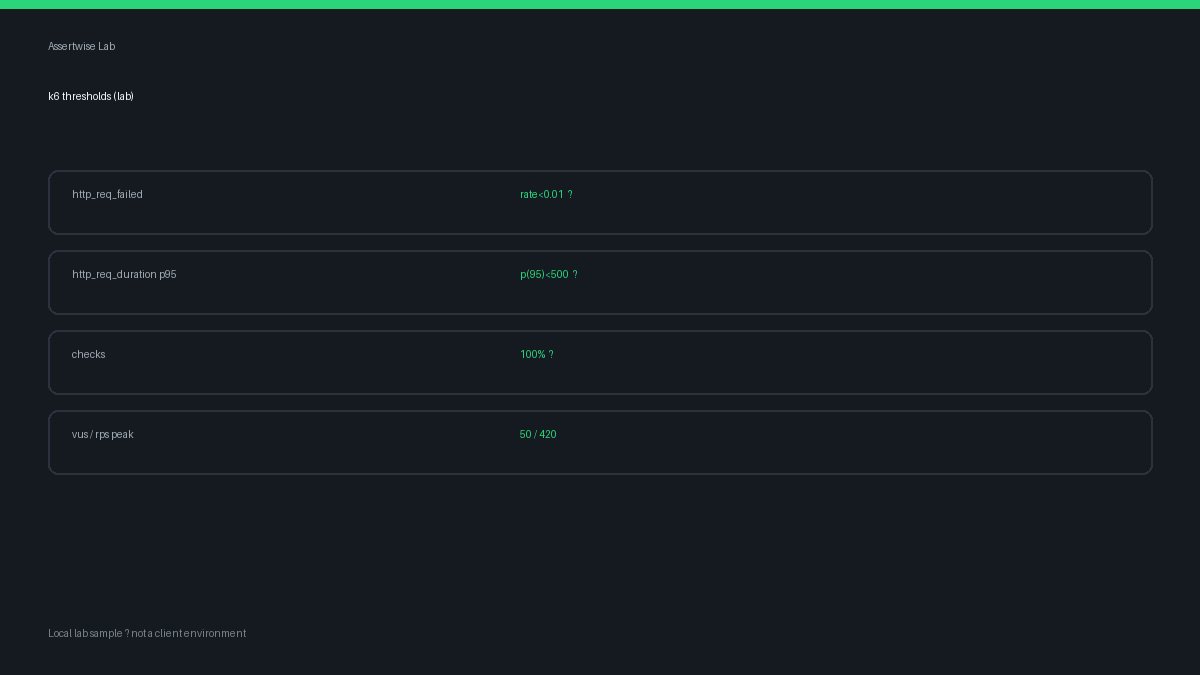
  thresholds: {
    http_req_failed: ['rate<0.01'],
    http_req_duration: ['p(95)<500'],
  },
};

export default function () {
  const res = http.post(
    `${__ENV.BASE_URL}/v1/checkout`,
    JSON.stringify({ sku: 'demo', qty: 1 }),
    { headers: { 'Content-Type': 'application/json', Authorization: `Bearer ${__ENV.TOKEN}` } },
  );
  check(res, { '201 or 200': (r) => r.status === 200 || r.status === 201 });
}
If maxVUs pegs and arrival falls short of 50/s, the report should say you could not sustain the offer — that is a result, not a silent green. Read percentiles with that in mind: reading performance test results.
JMeter can model open workloads with care (precise timers, throughput shaping, vigilance when threads block). Many inherited plans do not. If your JMeter plan is closed-loop and the question is arrival-rate, either rebuild the plan correctly or run the gate in k6.
When JMeter should stay
Keep JMeter as the system of record when at least two hold:
- The suite is large, mostly trusted, and the people who debug thread groups are on staff.
- Protocols or recorders you depend on are already there.
- There is no budget this quarter to re-home scenarios into git-first JS.
Then: freeze new API SLO work onto k6 (or a correctly open JMeter plan), and retire JMeter areas only when maintenance cost exceeds rewrite cost.
What this comparison is not
- Not “k6 is always modern, JMeter is obsolete.”
- Not a GUI tour or plugin catalogue.
- Not a full load-test methodology — that lives in the linked k6 and results posts.
If you want a written keep / migrate / dual-run call for your current load setup, request the free 20-minute check-up: you get a short note mapped to the table above plus a first scenario sketch. Performance engagement scoping: services.
Want a second pair of eyes on your system?
Request the free 20-minute check-up: short written findings, non-intrusive, no obligation.
Related hub: how to scope a SaaS load test.