
Seven ISTQB Testing Principles for Product Teams
Seven CTFL principles with fintech moves: EP/BVA lab for amount_cents, ownership HTTP checks, risk matrix, and a principles→API change worksheet.
ISTQB CTFL lists seven testing principles. For a SaaS or fintech team shipping weekly, they are operating rules: what testing can prove, where effort goes, and why a green build is not the same as a safe release. Each principle below has a concrete move, plus one shared lab on amount_cents and object IDs.
Series hub: CTFL map for online product teams. Official text: CTFL syllabus §1.3.
1. Testing shows defects, not their absence
Passing tests lower the chance that those defects remain. They do not prove the system is correct.
Do this: treat CI green as “known risks for this suite were not triggered.” Keep an explicit untested-risk list on the release gate.
Release gate note
Suite: api-authz  → green
Untested this sprint: admin bulk export of KYC PDFs (charter booked Thu)
2. Exhaustive testing is impossible
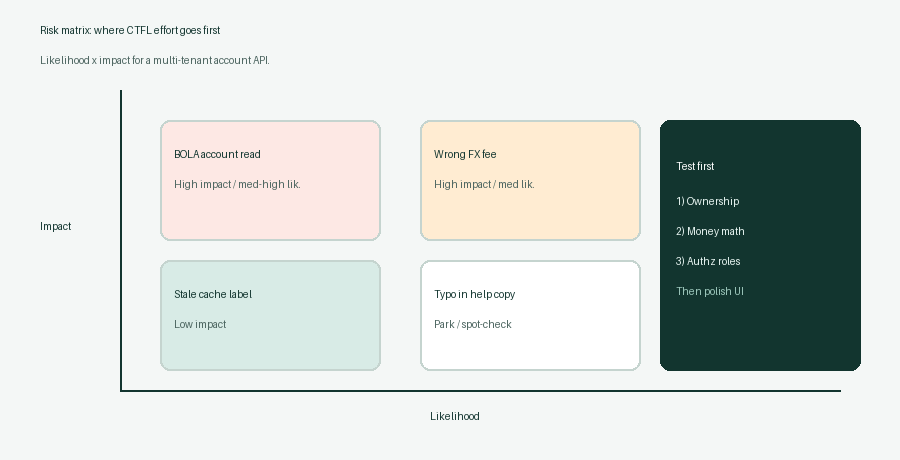
You cannot cover all inputs and paths. Use techniques, prioritization, and risk instead.
Do this: stop “test all amounts.” Derive EP/BVA from the contract.
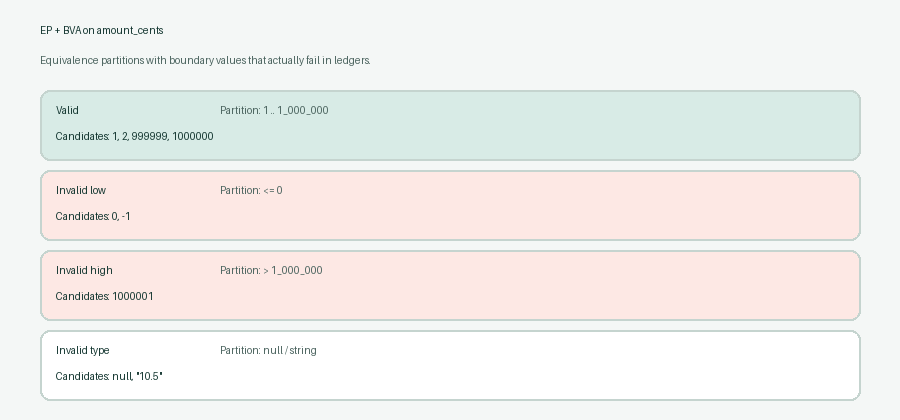
// amount.bva.test.js — illustrative
const cases = [
  [0, 400],
  [1, 201],
  [5000, 201],
  [1_000_000, 201],
  [1_000_001, 400],
];

for (const [amount_cents, status] of cases) {
  test(`amount_cents=${amount_cents} → ${status}`, async () => {
    const res = await createPayment({ amount_cents, currency: 'EUR' });
    expect(res.status).toBe(status);
  });
}
3. Early testing saves time and money
Defects removed early do not spawn downstream defects. Static + early dynamic both count.
Do this: reject stories that omit principal, ownership, retry semantics, or failure states.
Story DoR checklist
[ ] Principal source (JWT claim names)
[ ] Object IDs client may send
[ ] Retry / Idempotency-Key behaviour
[ ] Failure states + user-visible errors
4. Defects cluster together
A small set of modules often holds most defects (Pareto-style). Past clusters inform risk focus.
Do this: for two releases, tag bugs by module (authz-middleware, webhook-ingest, fee-engine). Weight next sprint’s tests toward the hot modules.
5. Tests wear out
Repeating the same tests finds fewer new defects. Automated regression still detects change; it does not replace new analysis when the surface grows.
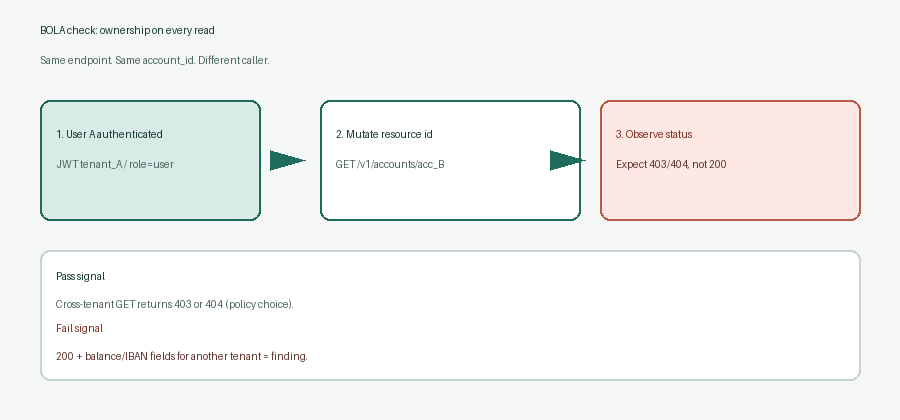
Do this: new resource with IDs → add new cross-tenant negatives. Do not assume last quarter’s happy path covers the new attack surface.
# New resource shipped: /v1/beneficiaries/{id}
# Add to CI the same day:
GET /v1/beneficiaries/{id_owned_by_B}
Authorization: Bearer <token_A>
→ expect 403 or 404
6. Testing is context dependent
A marketing site, a medical device, and a multi-tenant lending API do not share depth or exit criteria.
Do this: put context in the plan header: data class (PII/KYC), cadence, who accepts residual risk.
7. Absence-of-defects fallacy
Verifying every written requirement and fixing every found defect can still yield the wrong product. Specs can be wrong.
Do this: pair validation with verification — real borrower path + exploratory charter for support workflows the ticket never listed.
Lab: principles → one API change
Change: POST /v1/payments now accepts amount_cents.
| Principle | Action on this change |
|---|---|
| 1 | Green BVA suite ≠ “payments are correct” — note untested PSP lag |
| 2 | Cases from EP/BVA diagram, not “random amounts” |
| 3 | Spec review before coding the handler |
| 4 | If fee-engine was hot last month, add fee interaction cases |
| 5 | Extend suite; don’t only re-run old transfer tests |
| 6 | Document EUR-only vs multi-currency context |
| 7 | UAT: merchant can complete a real payout path |
Quick reference
| # | Principle | Team move |
|---|---|---|
| 1 | Shows defects, not absence | Separate suite-pass from ship-safe |
| 2 | Exhaustive impossible | EP/BVA + risk list |
| 3 | Early testing | Spec review before code |
| 4 | Defects cluster | Weight hot modules |
| 5 | Tests wear out | Refresh when surface changes |
| 6 | Context dependent | State data class + cadence |
| 7 | Absence-of-defects fallacy | Validate real outcomes |
FAQ
Exam trivia only?
No. These principles explain why coverage % and “we tested everything” mislead stakeholders.
Which matter most for API authorization?
2, 3, and 4 together: you cannot try every ID; catch missing ownership in review; authz defects cluster in shared middleware.
Link to risk-based testing?
Principles 2 and 4 feed CTFL Ch.5 risk-based depth when time is short.
Next
- CTFL map (series hub)
- Part 2 (planned): test activities and testware
Sources
Want a second pair of eyes on your system?
Request the free 20-minute check-up: short written findings, non-intrusive, no obligation.