
ISTQB CTFL for Online Product Teams: A Practical Map
CTFL v4 as a shipping map for SaaS/fintech: levels diagram, BOLA HTTP example, EP/BVA on amount_cents, risk matrix, and a CI negative test.
ISTQB CTFL v4 is a shared vocabulary for software testing. For online product teams that release weekly, treat it as a decision map: what to test, at which level, how early, and when risk is low enough to ship. This guide walks the six CTFL chapters with fintech/API examples, diagrams, and checks you can put in CI.
Exam study still belongs in the official CTFL syllabus PDF. This article is for shipping safer releases.
Who this series is for
- Engineering leads without a dedicated QA function
- The first QA hire who must set process without drowning the team
- Product/tech pairs in EU, UK, and DACH SaaS or fintech (accounts, payments, KYC, multi-tenant APIs)
Out of scope: Advanced syllabi, tool tutorials, and exam dumps.
QA, QC, verification, validation
| Term | Focus | Concrete fintech example |
|---|---|---|
| QA | Process that prevents defects | Definition of Ready: every ID-bearing endpoint names the ownership rule |
| QC | Checking the product | Run GET /v1/accounts/{id} as User A with User B’s id → expect 403/404 |
| Verification | Built to the spec? | Story review: “tenant comes from the JWT, not the body” |
| Validation | Right product for the user? | Staging: support role can open a case without seeing another tenant’s KYC pack |
Testing is mostly QC. It works when QA choices (entry criteria, risk order, review habits) exist upstream.
Worked example: one endpoint, four CTFL lenses
Endpoint under change:
GET /v1/accounts/{account_id}
Authorization: Bearer <access_token>| CTFL lens | Question | Example answer |
|---|---|---|
| Static (Ch.3) | Is ownership specified? | “account.tenant_id must equal token.tenant_id” |
| Level (Ch.2) | Cheapest place to catch a miss? | Component-integration / API test — not a full UI journey |
| Technique (Ch.4) | How to derive cases? | Two tenants; swap ids; also BVA on pagination cursors if any |
| Risk (Ch.5) | How deep this sprint? | High×High → must-run in CI; block merge on 200 |
Broken path (authentication only):
GET /v1/accounts/acc_B HTTP/1.1
Host: api.example.com
Authorization: Bearer eyJhbGciOi... # token for User A / tenant AHTTP/1.1 200 OK
Content-Type: application/json
{
"id": "acc_B",
"tenant_id": "tenant_B",
"balance_cents": 128450,
"iban_masked": "DE** bil"
}That 200 with another tenant’s data is object-level authorization failure (OWASP API1 / BOLA). CTFL does not invent that name — it gives you the process vocabulary to catch it early and prove the fix.
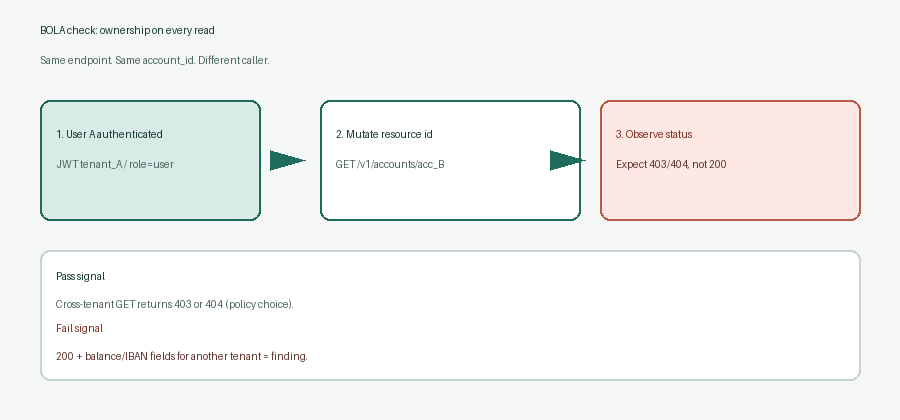
Fixed data access pattern:
SELECT id, balance_cents, iban_masked
FROM accounts
WHERE id = $1
  AND tenant_id = $2;  -- $2 from verified token claims
Negative contract test (must stay red if ownership regresses):
// bola.accounts.test.js
import { test, expect } from 'vitest';

test('User A cannot read User B account', async () => {
  const tokenA = await loginAs('[email protected]');
  const res = await fetch(`${API}/v1/accounts/${accountIdB}`, {
    headers: { Authorization: `Bearer ${tokenA}` },
  });
  expect([403, 404]).toContain(res.status);
});
The six CTFL v4 chapters as a product roadmap
Chapter 1 — Fundamentals
Seven principles, test activities, testware, skills. Testing reduces the chance of escaped defects; it does not prove correctness. Exhaustive testing is impossible → techniques + risk.
Ship this week: list three release risks (object IDs, money rounding, webhook retries).
Next deep dive: Seven ISTQB testing principles.
Chapter 2 — Testing throughout the SDLC
DevOps, shift-left, five test levels, test types, confirmation vs regression.
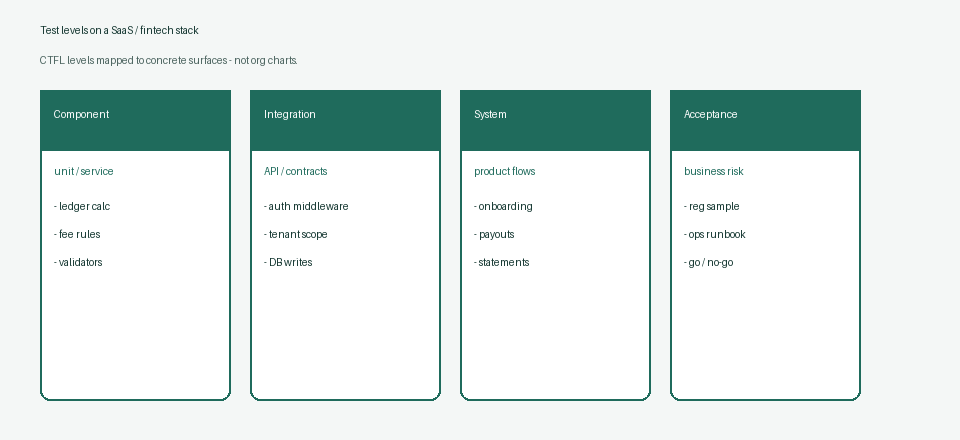
| Level | Fintech example test object |
|---|---|
| Component | roundHalfEven(amountCents, fxRate) |
| Component integration | Ledger service + notification outbox |
| System | Borrower journey in your app |
| System integration | PSP settlement webhook + your API |
| Acceptance | Ops can reconcile day-end with the bank file |
Ship this week: label every planned check for one money feature with a level. Delete E2E that only re-checks unit math.
Chapter 3 — Static testing
Reviews and static analysis find defects without executing code.
Refinement prompts (paste into the ticket template):
- Who is the principal (user, service, admin)?
- Which object IDs can the client send?
- What happens on retry / duplicate idempotency key?
- Which fields are PII / KYC and who may see them?
Chapter 4 — Test analysis and design
Black-box (EP, BVA, decision tables, state transition), white-box, experience-based.
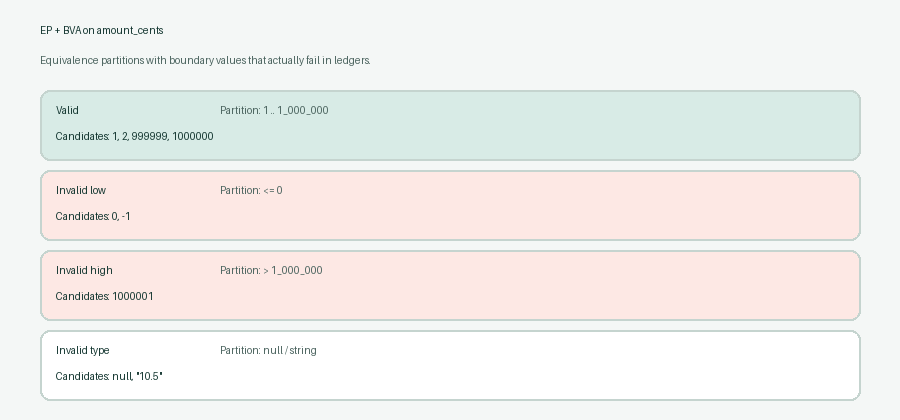
Example cases derived from that diagram:
| Case | amount_cents |
Expect |
|---|---|---|
| Invalid below | 0 |
400 |
| Min valid | 1 |
201/200 |
| Mid valid | 5000 |
201/200 |
| Max valid | 1000000 |
201/200 |
| Invalid above | 1000001 |
400 |
| Wrong type | 12.34 or "1e3" |
400 if contract is integer |
Chapter 5 — Managing the test activities
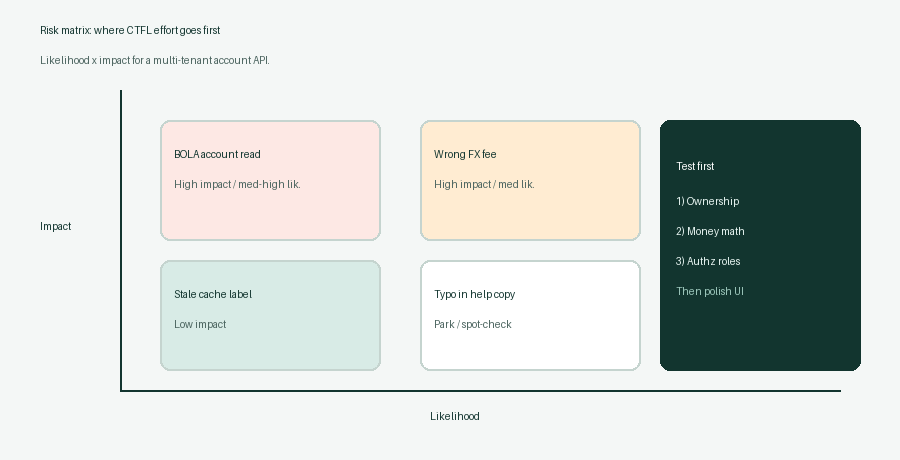
Planning, estimation, risk-based testing, monitoring, defects.
Chapter 6 — Test tools
Tools follow the map: unit runner → API negatives → few E2E → load where SLOs exist → targeted security. Tools without goals create noise.
One-page operating model (no QA department)
- Risks first (Ch.5)
- Review the spec (Ch.3)
- Thin case set (Ch.4)
- Right level (Ch.2)
- Automate must-not-regress (Ch.2 + 6)
- Keep evidence (Ch.1)
- Gate the release (Ch.5)
Series roadmap
| Part | Topic |
|---|---|
| 0 (this) | Practical map + worked BOLA example |
| 1 | Seven testing principles |
| 2 | Test activities & testware |
| 3–12 | Levels, types, shift-left, static, EP/BVA, states, exploratory, risk, plans, tools |
FAQ
Is CTFL only for certificates?
No. Same chapters are a shared language for planning, reviews, and release debates.
CTFL v3 or v4?
Use v4 (v4.0.1 maintenance where your board points). Levels and DevOps/shift-left coverage differ from v3.
Why not “automate everything”?
Automation without levels, risk, and oracles produces brittle suites. CTFL helps decide what and where.
Do we need CT-FT too?
ISTQB Finance Testing (CT-FT) is a specialist add-on. Build CTFL habits first.
Related on Assertwise
- Services · How we work · About
Sources
For a one-page sprint strategy when you have no QA hire, see test strategy without a QA team.
Want a second pair of eyes on your system?
Request the free 20-minute check-up: short written findings, non-intrusive, no obligation.