
ISTQB Test Activities & Testware: What Evidence to Keep
CTFL §1.4 for product teams: planning→completion activities, which testware to keep, traceability, and a BOLA-style finding evidence pack with HTTP + CI script.
CTFL section 1.4 defines a test process as a set of activities — planning, monitoring and control, analysis, design, implementation, execution, completion — and the testware each one produces. For a SaaS or fintech team, the useful question is not “did we fill the ISTQB form?” It is: can another engineer reproduce the failure and see why it matters from the artifacts alone?
Series: CTFL map · Seven principles. Syllabus: CTFL v4 §1.4.
The activities (not a waterfall)
CTFL lists activity groups in a logical order. In product teams they run iteratively and in parallel (analyse the next story while yesterday’s suite executes). Monitoring and control is continuous, not a single step.
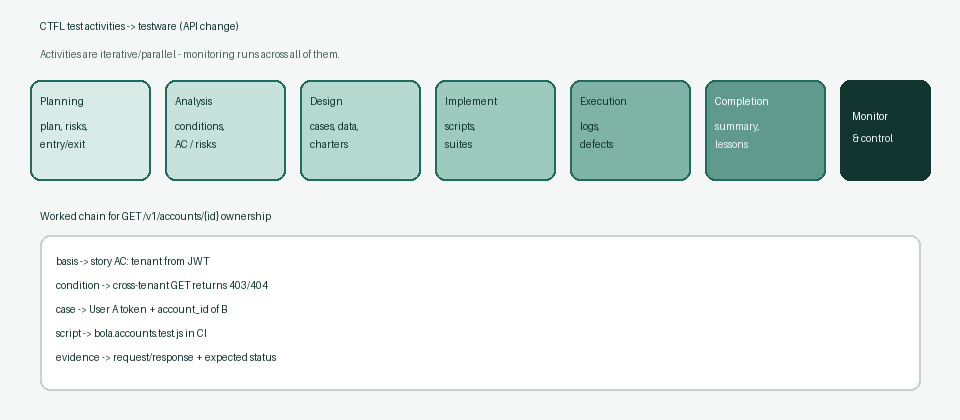
| Activity | Answers | Typical testware (lean team) |
|---|---|---|
| Planning | What / why / exit | One-page plan, risk list, entry/exit |
| Monitoring & control | Are we on track? | CI status, flake rate, open Highs |
| Analysis | What to test? | Test conditions from AC / risks |
| Design | How to test? | Cases, charters, data needs |
| Implementation | Ready to run? | Scripts, fixtures, suites, env notes |
| Execution | What happened? | Logs, results, defect reports |
| Completion | What do we keep? | Summary, lessons, backlog items |
Worked example: one story through the process
Test basis (user story AC):
As a tenant user I can view my accounts.
Acceptance:
- Authenticated users only
- account.tenant_id must equal token.tenant_id
- Foreign account id → 403 or 404 (product chooses; be consistent)
Analysis → conditions
C1  Valid owner can GET own account → 200
C2  User A + account_id of B → 403 or 404
C3  Missing/invalid token → 401
C4  Spec defect if AC omits ownership (raise in review — static)
Design → cases
| ID | Condition | Steps (summary) | Expected |
|---|---|---|---|
| TC-C2 | C2 | Login A; GET /v1/accounts/{id_B} |
403 or 404 |
| TC-C1 | C1 | Login A; GET /v1/accounts/{id_A} |
200, own fields only |
Implementation → script
// bola.accounts.test.js
import { test, expect } from 'vitest';

test('TC-C2 cross-tenant account read denied', async () => {
  const tokenA = await loginAs('[email protected]');
  const res = await fetch(`${API}/v1/accounts/${ACCOUNT_B}`, {
    headers: { Authorization: `Bearer ${tokenA}` },
  });
  expect([403, 404]).toContain(res.status);
});
Execution → evidence when it fails
If the suite returns 200 with tenant B data, execution testware is not “test failed.” It is a defect report with replayable evidence.
GET /v1/accounts/acc_B HTTP/1.1
Host: api.example.com
Authorization: Bearer eyJhbGciOi... # User AHTTP/1.1 200 OK
Content-Type: application/json
{
"id": "acc_B",
"tenant_id": "tenant_B",
"balance_cents": 128450
}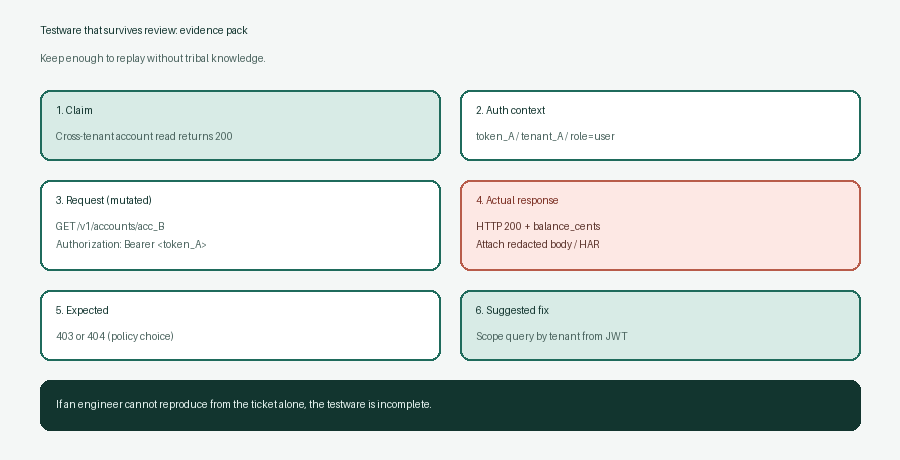
Finding template (execution testware)
FINDING · High · API authorization (BOLA-class)
Claim:     GET /v1/accounts/{id} returns another tenant’s account when id is swapped.
Evidence:  token_A + ACCOUNT_B → HTTP 200 + balance_cents (redacted HAR attached).
Expected:  403 or 404 per AC.
Cause:     Query by id only; tenant not taken from verified token.
Action:    WHERE id=? AND tenant_id=?; add TC-C2 to CI merge gate.
Trace:     Story AW-184 · condition C2 · case TC-C2 · job api-authz#412
That block is CTFL defect report language in a form engineers will actually use.
Traceability (why CTFL insists on it)
CTFL 1.4.4: keep links between test basis ↔ testware ↔ results ↔ defects.
Lean mapping that fits a 15-person team:
AW-184 (story)
  └─ C2 (condition)
       └─ TC-C2 (case) → bola.accounts.test.js
            └─ CI job api-authz
                 └─ Finding F-12 (if red) / green check (if pass)
Without that chain you cannot answer: “which tests does this AC need?” or “which AC did this failure break?”
Roles without a QA department
CTFL compares a test management role (plan, monitor, report) with a testing role (analyse, design, execute). In a small SaaS team one person may wear both — still separate the hats in the artifacts:
| Hat | Owns |
|---|---|
| Management | Exit criteria, risk order, “ship / don’t ship” note |
| Testing | Conditions, cases, scripts, evidence packs |
Context changes the process (1.4.2)
Same activities, different depth:
| Context | Implementation testware | Evidence bar |
|---|---|---|
| Marketing site copy | Manual checklist | Screenshot |
| Multi-tenant payments API | Automated negatives in CI | HTTP request/response + expected status |
| Regulated KYC export | Cases + access matrix + retention note | Who ran it, on which dataset, when |
Completion: what to archive
At sprint or release end, CTFL completion keeps what future you will need:
- Which High findings remain open (with owners)
- Which suites are merge-gating vs nightly
- Lessons (e.g. “ownership AC missing twice — update DoR”)
- Scripts and fixtures under version control (configuration management)
Do not archive 40 screenshots of green runs. Archive failing evidence and the gate definition.
Checklist: minimum testware for an API risk
- Condition written from AC or risk (not only a script name)
- Case with principal + object id + expected status
- Automated or charter step that can be re-run
- On failure: claim, auth context, request, actual, expected, fix hint
- Trace id back to story / risk
- Exit criterion that names this check if it is High×High
FAQ
Do we need IEEE/ISO document names?
No. CTFL cares that the activities and work products exist. Name them plan, condition, case, log, finding — consistency beats ceremony.
Is a CI log enough evidence?
A red job is a signal. A finding needs the replayable request and expected result. Attach or link both.
Where do exploratory charters sit?
Design testware (alongside cases). Execution still produces notes/evidence; interesting failures become defect reports.
How does this connect to the seven principles?
Principle 1: green suite ≠ absence of defects — completion must list untested risks. Principle 5: refresh cases when surfaces change — that is design/implementation work, not only re-execution.
Next in the series
- CTFL map · Seven principles
- Part 3 (planned): five test levels on multi-tenant SaaS
Related on Assertwise
Sources
For a release-level Markdown test plan template, see test plan template for SaaS.
Want a second pair of eyes on your system?
Request the free 20-minute check-up: short written findings, non-intrusive, no obligation.